Quick answer: Plan around the board’s diameter, door clearance, scoreboard space and safe anchoring. Complete the cabinet before making final bull and oche measurements.
Draw around real components
Measure board diameter, depth, bracket, stabilizers, number-ring clearance, and dart length. Add door swing, scoreboard space, lighting clearance, and hand access for rotation. Create a full-size cardboard layout before cutting wood. It reveals whether doors, chalkboards, dart storage, and a light can coexist without crowding the number ring or throwing shadows.
Apply this point specifically to build dartboard cabinet: Create a full-size cardboard layout before cutting wood. It reveals whether doors, chalkboards, dart storage, and a light can coexist without crowding the number ring or throwing shadows. Before deciding, compare the actual component with the room and the people who will use it. Record the relevant measurement or condition instead of relying on memory after installation.
Stop if the board becomes unstable, the lane cannot be isolated, a component is damaged, or the instructions conflict with the planned method. Performance never justifies uncertain anchoring, incompatible darts, exposed electrical parts, or a hidden ingestion hazard.
Select stable materials
Use flat cabinet-grade sheet or properly joined boards that will not twist. Round exposed edges and avoid mirrors, glass, brittle trim, or protruding metal near missed darts. Wood movement and cabinet twist can bind doors or pull the board out of level. Straight dry stock, square joinery, and a rigid back are functional requirements rather than furniture refinements.
Wood movement and cabinet twist can bind doors or pull the board out of level. Straight dry stock, square joinery, and a rigid back are functional requirements rather than furniture refinements. In practical terms, the select stable materials check should happen before appearance or bonus features influence the decision. A seller's label is useful only when the construction, instructions, and physical setup support it.
A useful result should be visible in safer installation, more dependable scoring, or slower wear—not merely a neater description. If the select stable materials requirement cannot be verified, pause the purchase or project until the missing specification is available.
Join and finish before mounting
Build the box square, fit doors with positive catches, seal or paint away from the target, and let finishes cure fully. Keep combustible finishes away from hot lighting. Locate scoreboard hardware outside common misses and keep stored darts inaccessible to children. Catches should hold doors closed without sharp projections near hands or flights.
For build dartboard cabinet, this distinction prevents a common category error. Locate scoreboard hardware outside common misses and keep stored darts inaccessible to children. Catches should hold doors closed without sharp projections near hands or flights. Inspect the exact product or project at hand, because a rule that suits sisal may be wrong for a sensor board, flexible target, or specialty layout.
This is also where material type matters. Sisal, electronic plastic, and magnetic construction respond differently to impact, cleaning, storage, and modification. Keep the recommendation attached to the exact board rather than generalizing it to every dart target.
Anchor, then measure
Fasten to studs when possible or use rated hardware for the wall and total load. Mount the board independently as designed, confirm stability, and establish bull height and oche from its final face. The cabinet center is only a preliminary reference. Regulation height belongs to the bull, and throw distance begins at the final playing face after every layer and bracket is installed.
The cabinet center is only a preliminary reference. Regulation height belongs to the bull, and throw distance begins at the final playing face after every layer and bracket is installed. Turn that fact into a repeatable check: observe the condition, verify the maker's instructions, make one controlled change, and reassess. That approach is safer than improvising several fixes and losing track of the cause.
Document the decision with a measurement, dated photo, manual reference, or parts list when appropriate. That small record makes later maintenance and troubleshooting more reliable and helps another household member preserve the intended setup.
Current equipment to compare
Use these verified listings as a starting set, then confirm the selected variation, dimensions, compatibility and current order terms on the retailer page. Inclusion is not a claim of hands-on testing or a universal ranking.
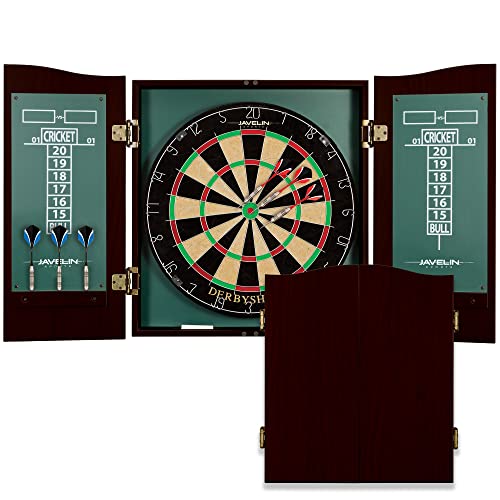
EastPoint Derbyshire Official Size Dart Board Cabinet, 6 Steel Tip Darts
Check availability on Amazon ↗Paid link · #CommissionsEarned
Accudart Armada Bristle Dartboard Cabinet Set, 18-Inch
Check availability on Amazon ↗Paid link · #CommissionsEarned
As an Amazon Associate, we earn from qualifying purchases. Product links are paid links; availability can change.
Turn the answer into a better game
Use the relevant tool or playing guide next instead of leaving the answer on the screen. You can play the Road to the Crown darts game, measure a lane with the setup calculator, or return to our dart boards homepage to compare board types and plan a complete setup.
Frequently asked questions
How deep should it be?
Deep enough for the exact board, bracket, stabilizers, and closed doors without pressure on the spider.
Can the board screw to a cabinet back?
Only when the back and fasteners safely support the board’s specified mount and repeated removal force.
Should lights go inside?
Only approved low-heat fixtures installed with safe wiring and adequate clearance.
The Throw Lab verdict
Build from the target and structural load outward. Accurate joinery matters, but anchoring, nonhazardous materials, door clearance, and final lane measurements decide whether the cabinet is safe. A freestanding commercial cabinet or professional installation is better when the wall cannot be confidently assessed. Recheck the exact board manual and the rules used by the intended players whenever either could change the recommendation.