Quick answer: Mount the bullseye at 5 ft 8 in (1.73 m). For steel-tip darts, measure 7 ft 9¼ in (2.37 m) horizontally from the board face to the oche; the diagonal is 9 ft 7⅜ in (2.93 m).
The three regulation measurements
Measure the bullseye to the floor vertically, not along the wall. The centre of the inner bull should land at 68 inches. Next, project the board face down to the floor and measure 93.25 inches horizontally to the player-facing edge of the oche. Because a bristle board stands proud of the wall, measuring from the wall makes the lane too long.
A diagonal measurement of 115.375 inches from the bull to the oche provides a useful verification for steel-tip play. It should confirm the vertical and horizontal measurements rather than replace them; an incorrect board height can still produce a misleading diagonal if the tape is not held accurately.
How to mark the board face on the floor
Hang the board first, then hold a plumb line at the playing face—not at the mounting bracket. Mark the point directly below that face with removable tape. Run the measuring tape from this projected point to the front of the throw line, keeping the tape level with the floor and square to the board.
A raised oche has a physical front edge that the toe cannot cross. With tape or a floor marker, the edge nearest the board is the legal boundary. A dart mat with a printed line is only accurate after its board-end reference has been aligned with the projected face.
Steel-tip and soft-tip differences
Standard steel-tip geometry uses the 7-foot-9 1/4-inch horizontal throw. Soft-tip competition is often played from 8 feet, although local leagues and machine operators can specify their own rules. The bull height normally remains 5 feet 8 inches. Never assume an electronic cabinet’s mounting holes automatically place its bull at regulation height.
If the room hosts both formats, mark two clearly labelled oches or use a mat showing both distances. Players should know which line applies before a leg begins; shifting between them during a match changes the release point and invalidates comparisons between practice sessions.
A reliable installation sequence
Level the board so the 20 is centred at the top, verify the bull at 68 inches, and then mark the steel-tip oche from the face. Recheck after fitting a surround, cabinet or sound-damping layer because these additions can move the board outward. A laser can help keep the lane square, but a tape and plumb line remain the decisive measuring tools.
Finally, stand at the oche and inspect the entire throwing corridor. Regulation numbers do not make a lane safe if a doorway, ceiling fan, fragile object or spectator position crosses the path. Keep the area behind and beside the player clear enough for an uninterrupted stance and follow-through.
Troubleshooting measurements that disagree
If the diagonal check does not match after height and horizontal distance are set, inspect the tape path before moving the board. A tape pulled to the wall instead of the face, held above the floor, or placed at the far side of a thick oche can explain the difference. Confirm the bull mark from a level floor and use a rigid straightedge to project the playing face when a plumb line is unavailable.
Rooms with baseboards create another trap: the wall surface near the floor may sit forward of the mounting wall, but neither surface is the regulation reference. Record the finished measurements beside the lane so a moved mat or rotated cabinet can be corrected quickly. Recheck after tightening mounts, because a heavy board can settle enough to make a careful initial mark inaccurate.
Current equipment to compare
Use these verified listings as a starting set, then confirm the selected variation, dimensions, compatibility and current order terms on the retailer page. Inclusion is not a claim of hands-on testing or a universal ranking.
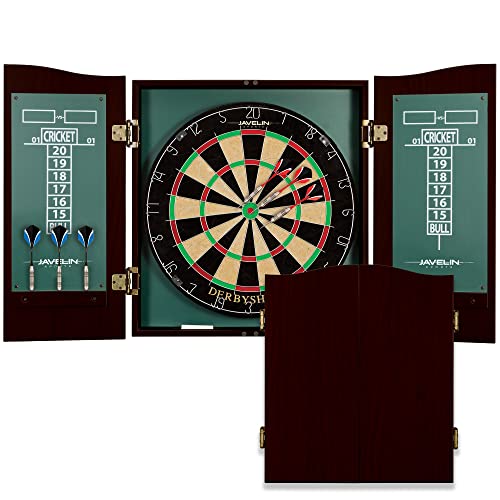
EastPoint Derbyshire Official Size Dart Board Cabinet, 6 Steel Tip Darts
Check availability on Amazon ↗Paid link · #CommissionsEarned
Accudart Armada Bristle Dartboard Cabinet Set, 18-Inch
Check availability on Amazon ↗Paid link · #CommissionsEarned
As an Amazon Associate, we earn from qualifying purchases. Product links are paid links; availability can change.
Turn the answer into a better game
Use the relevant tool or playing guide next instead of leaving the answer on the screen. You can play the Road to the Crown darts game, measure a lane with the setup calculator, or return to our dart boards homepage to compare board types and plan a complete setup.
Frequently asked questions
Do I measure dartboard distance from the wall or board?
Measure from the front playing face of the board. Starting at the wall ignores the board and mounting depth and makes the actual throw longer than regulation.
Is the dartboard distance different for soft-tip darts?
Often, yes. Steel-tip uses 7 feet 9 1/4 inches; many soft-tip rules use 8 feet. Confirm the rules of the machine, venue or league.
Can I use the diagonal measurement by itself?
Use 9 feet 7 3/8 inches as a steel-tip cross-check. Establish the 5-foot-8-inch bull height and horizontal oche distance independently first.
The Throw Lab verdict
A correct lane begins at the board face: bull at 5 feet 8 inches, steel-tip oche at 7 feet 9 1/4 inches, and a 9-foot-7 3/8-inch diagonal check. Soft-tip commonly extends the horizontal distance to 8 feet. Mark the face on the floor with a plumb line, measure to the player-facing edge of the oche, then recheck after adding cabinets or backing. Those few steps prevent the most common home-installation error and give every practice session a repeatable geometry.