Quick answer: Use a purpose-built surround, dense backboard or cabinet extending beyond the board’s edge. Choose enough coverage for the skill level of the players.
Match coverage to likely misses
A regulation board is roughly 17.75 inches across, but a beginner’s misses can land far outside that circle. A fitted surround adds a modest safety margin without changing the traditional look. For a family room or first setup, a rectangular panel extending well above, below and to both sides of the target offers more forgiving coverage.
Study where misses actually collect after several sessions. Low darts are common when players tire, while lateral misses appear during release problems. Protection should follow evidence rather than being centred only for visual symmetry.
Materials that stop steel points
Dense cork, layered softwood, rubberized dartboard backing and purpose-built foam can absorb a point without causing a sharp bounce-back. Thickness matters as much as material. A quarter-inch decorative tile may hide old marks but can still allow a steel tip to reach drywall.
Avoid metal sheets, glass, ceramic and exposed masonry in the miss zone. These surfaces can damage points or send darts back toward players. If wood is used, choose a surface that does not splinter badly and remove protruding screws from the visible impact area.
Surround, cabinet or full backboard
Choose a surround when space is tight and players already group reasonably near the board. A cabinet suits a finished game-room appearance and keeps darts and manual scoreboards together, although open doors provide only limited additional coverage. A broad backboard is the practical choice for new players or valuable walls.
Combinations are possible: a surround can sit inside a larger decorative panel, or a cabinet can mount on a protected backer. Check that added layers do not prevent the board from sitting stable and parallel to the wall.
Install without changing regulation distance
Fit the protective layer before measuring the oche because it may move the board face into the room. Mount the bull at 5 feet 8 inches, then measure 7 feet 9 1/4 inches from the final playing face for steel-tip. Never preserve an old wall-based line after adding a thick panel.
Anchor the backing independently where practical, especially if it is heavy. Confirm the dartboard bracket is fixed to suitable structure, the board cannot rock, and the number ring can still be rotated for even wear.
Balance appearance, maintenance and fire safety
A backboard becomes a permanent part of the room, so choose finishes that tolerate repeated punctures without exposing bright substrate or loose fibers. Dark woven coverings can hide marks, but they must be stretched over the stopping material and kept clear of the board bracket. Removable panels make repairs simpler than a decorative treatment bonded directly across a large wall.
When adding foam, fabric or homemade layered materials, consider their location near lights, outlets and heaters. Use products appropriate for interior installation and do not cover electrical boxes or ventilation openings. A purpose-built surround provides clearer material expectations than an improvised panel. Whatever the design, periodically inspect for protruding points, fragments and soft spots that no longer stop misses reliably.
Current equipment to compare
Use these verified listings as a starting set, then confirm the selected variation, dimensions, compatibility and current order terms on the retailer page. Inclusion is not a claim of hands-on testing or a universal ranking.
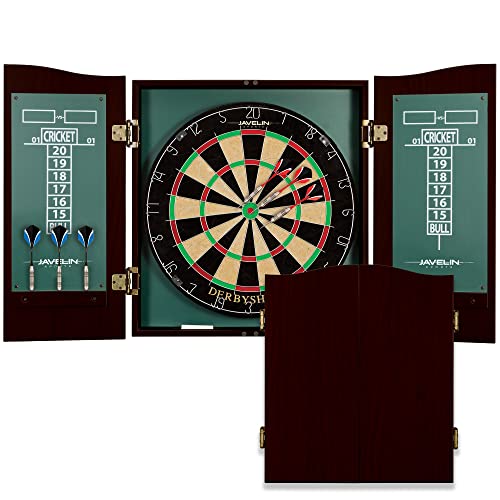
EastPoint Derbyshire Official Size Dart Board Cabinet, 6 Steel Tip Darts
Check availability on Amazon ↗Paid link · #CommissionsEarned
Accudart Armada Bristle Dartboard Cabinet Set, 18-Inch
Check availability on Amazon ↗Paid link · #CommissionsEarned
As an Amazon Associate, we earn from qualifying purchases. Product links are paid links; availability can change.
Turn the answer into a better game
Use the relevant tool or playing guide next instead of leaving the answer on the screen. You can play the Road to the Crown darts game, measure a lane with the setup calculator, or return to our dart boards homepage to compare board types and plan a complete setup.
Frequently asked questions
Is cork board thick enough behind a dartboard?
Only if it is dense and thick enough to stop the point before it reaches the wall. Thin craft or decorative cork tiles are commonly inadequate.
How large should dartboard backing be?
There is no single required size. Cover the realistic miss area for the least experienced user, with extra room below and to both sides when space permits.
Can acoustic foam protect a wall from darts?
Soft open-cell acoustic foam is designed for sound treatment, not point penetration. Use a product rated as dart backing or place a proven stopping layer behind it.
The Throw Lab verdict
Use a fitted surround for compact protection, a cabinet for storage and presentation, or a broad dense backboard when misses are less predictable. Verify the chosen material can stop a steel point at its installed thickness, remove hard rebound hazards, and anchor everything securely. Once the backing changes the board’s projection, reset the oche from the face. Protection should make the lane safer and easier to live with without compromising regulation geometry or board maintenance. Inspect the stopping surface periodically and replace it before points begin passing through.