Quick answer: A standard bristle board is about 17.75 inches in overall diameter, while its scoring area measures 13.2 inches across. Product frames and cabinets add width.
Overall board versus scoring area
The familiar round bristle board spans roughly 451 millimetres edge to edge. Within it, the official scoring beds occupy a 340-millimetre diameter measured to the outside of the doubles ring. The unused outer margin helps hold the sisal structure and provides room for the removable number ring.
Product listings sometimes quote the cabinet or backing panel rather than the target. Verify that the stated diameter belongs to the board itself and that the double-ring geometry is regulation if match-style practice is the goal.
Key ring and bull measurements
The inner bull is about 12.7 millimetres in diameter and scores 50; the outer bull extends to about 31.8 millimetres and scores 25. The treble ring sits around a 107-millimetre radius from the centre, and the double ring around 170 millimetres. Both narrow scoring bands are approximately 8 millimetres wide.
These small targets explain why a board that merely looks full-size may not reproduce tournament difficulty. A few millimetres of altered ring width changes the available scoring area and the visual spacing a player learns.
How much wall width the setup needs
A tight-fitting foam surround typically adds several inches around the board, while a cabinet may open to a width of three feet or more depending on its doors. A circular light ring adds further diameter and projection. Consult each accessory’s assembled dimensions rather than adding catalog widths casually.
Leave operating clearance, not just physical clearance. Cabinet doors must open fully, lighting should be accessible, and players need room to rotate or remove the board for maintenance. Nearby shelves should remain outside common miss zones.
Formats that are not the same size
Electronic boards use perforated plastic segments and vary widely in outer housing size; their playable target may follow a soft-tip standard without matching the dimensions of a bristle board’s frame. Children’s and magnetic products are often deliberately smaller. American darts uses a distinct board design and should not be treated as an English-board variant.
If a listing does not provide scoring-area dimensions, use product photographs only as a rough clue. For formal practice, seek explicit regulation language and verify the measurements after delivery before permanently marking the lane.
Measure a product before planning cabinetry
Before cutting a recess or ordering a custom surround, measure the delivered board at several points. Retail dimensions may include the number ring, packaging may round values, and handmade cabinets can be slightly out of square. Leave enough tolerance to remove the board, adjust its rear supports and rotate the number ring without scraping the finish. Ventilation and cable access matter when an electronic scorer or light is enclosed.
Create a full-size paper or cardboard template showing the outer board, open cabinet doors and proposed light. Tape it to the wall at bull height and view it from the oche. This inexpensive mock-up reveals conflicts with switches, shelving and sightlines before holes are drilled. It also distinguishes the target’s compact scoring field from the much larger working envelope the finished installation requires.
Current equipment to compare
Use these verified listings as a starting set, then confirm the selected variation, dimensions, compatibility and current order terms on the retailer page. Inclusion is not a claim of hands-on testing or a universal ranking.
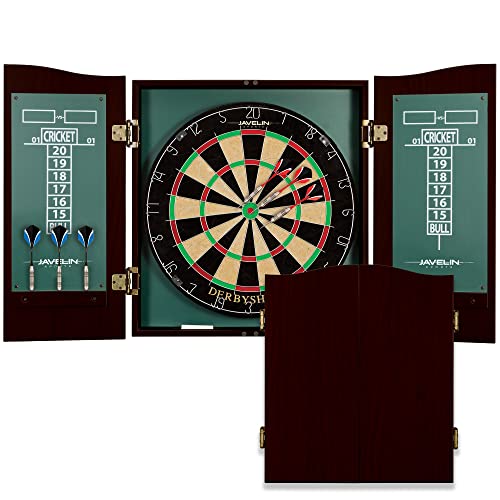
EastPoint Derbyshire Official Size Dart Board Cabinet, 6 Steel Tip Darts
Check availability on Amazon ↗Paid link · #CommissionsEarned
Accudart Armada Bristle Dartboard Cabinet Set, 18-Inch
Check availability on Amazon ↗Paid link · #CommissionsEarned
As an Amazon Associate, we earn from qualifying purchases. Product links are paid links; availability can change.
Turn the answer into a better game
Use the relevant tool or playing guide next instead of leaving the answer on the screen. You can play the Road to the Crown darts game, measure a lane with the setup calculator, or return to our dart boards homepage to compare board types and plan a complete setup.
Frequently asked questions
Is every 18-inch dartboard regulation size?
Not necessarily. Overall diameter may be rounded for marketing. Confirm the 451-millimetre board and 340-millimetre doubles diameter or recognized competition specifications.
How wide is the scoring part of a dartboard?
The diameter to the outside of the doubles ring is approximately 340 millimetres, or 13.2 inches.
Does a dartboard cabinet change the throw distance?
The cabinet can move the board face outward. Always measure the oche from the installed playing face, not from the wall or cabinet back.
The Throw Lab verdict
Think of a regulation board as a 17.75-inch target containing a precisely proportioned 13.2-inch scoring field. Ring and bull dimensions—not a rounded retail diameter—create authentic practice. Plan separately for the cabinet, surround and lighting because these determine the actual wall footprint and can change board projection. For electronic, magnetic or American formats, use the manufacturer’s or governing rules rather than applying bristle-board dimensions to a different game. A template of the entire assembly is the safest basis for custom cabinetry.