Quick answer: The steel-tip throw line is 7 ft 9¼ in from the face of the board, not the wall. Soft-tip competition commonly uses 8 ft, so verify the rules for your board or league.
Where the tape measure must begin
Drop a plumb line from the board’s playing surface and place a small floor mark directly below it. This removes the guesswork created by cabinets, wall spacers and mounting hardware. Measure 93.25 inches from that mark for steel-tip play, keeping the tape straight down the centre of the lane.
Do not hook the tape onto the baseboard. A regulation bristle board is roughly 1.5 inches thick, and a cabinet or acoustic panel can push it farther into the room. Wall-to-line measurements therefore create different throwing distances on different installations.
Which edge of the line counts
The legal boundary is the edge of the oche nearest the dartboard. A player may lean over that vertical plane, but the foot cannot touch the floor beyond it while releasing a dart. If using tape, make the near edge exactly 7 feet 9 1/4 inches from the board face rather than placing the tape’s centre on the measurement.
For a wooden raised oche, measure to its board-facing vertical edge. The block should be firmly fixed or sufficiently stable that repeated toe contact cannot creep it forward during play.
Choosing steel-tip or soft-tip distance
Steel-tip’s recognized horizontal distance is 2.37 metres. Many electronic and soft-tip organizations use 2.44 metres, or 8 feet, although a machine’s operator manual or league rules take priority. An electronic board may also have a different cabinet depth, reinforcing the need to measure from the target face.
A dual-purpose room can carry two color-coded floor marks. Label each line rather than relying on memory, and align both on the same centreline so the player faces the bull squarely.
Checking that the line is square
Measure from the projected centre of the board face, then compare the distance at both ends of a wide oche. Equal diagonal checks from consistent points help reveal a crooked line. A builder’s square or laser projected perpendicular to the wall can simplify this step.
Also verify the bull is 5 feet 8 inches high. The throw distance can be perfect while the target is still mounted incorrectly. For steel-tip, the bull-to-oche diagonal should read 9 feet 7 3/8 inches when the height and horizontal distance are both correct.
Make the boundary durable and unambiguous
A temporary painter’s-tape oche is useful during layout, but replace it with a durable marker once the position is verified. Floor decals should resist curling, mats should lie flat, and a raised block should not slide when a player presses a toe against it. A crooked or migrating line gradually changes both distance and body alignment, undermining score comparisons across practice sessions.
Photograph the final tape measurement with the hook at the projected face mark and the blade crossing the near edge of the line. This creates a simple installation record for a household or club. When flooring is replaced or the board is remounted, repeat the measurement rather than restoring the oche from furniture, grout lines or other room references that may have shifted.
Current equipment to compare
Use these verified listings as a starting set, then confirm the selected variation, dimensions, compatibility and current order terms on the retailer page. Inclusion is not a claim of hands-on testing or a universal ranking.
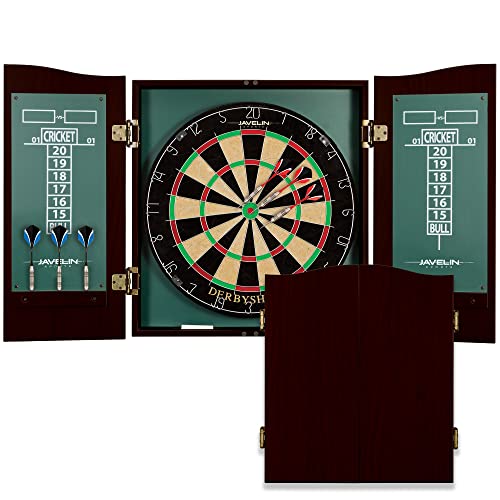
EastPoint Derbyshire Official Size Dart Board Cabinet, 6 Steel Tip Darts
Check availability on Amazon ↗Paid link · #CommissionsEarned
Accudart Armada Bristle Dartboard Cabinet Set, 18-Inch
Check availability on Amazon ↗Paid link · #CommissionsEarned
As an Amazon Associate, we earn from qualifying purchases. Product links are paid links; availability can change.
Turn the answer into a better game
Use the relevant tool or playing guide next instead of leaving the answer on the screen. You can play the Road to the Crown darts game, measure a lane with the setup calculator, or return to our dart boards homepage to compare board types and plan a complete setup.
Frequently asked questions
Is the dart line 7 feet or 8 feet away?
Steel-tip is 7 feet 9 1/4 inches from the board face. Soft-tip is commonly 8 feet, subject to the machine or league rules.
Can my foot hang over the dart line?
Your body may lean beyond the line, but a supporting foot cannot contact the floor past the board-facing edge when the dart is released.
Where should I place tape for the oche?
Place the tape so its edge nearest the board is exactly on the measured boundary. Measuring to its centre shortens the legal lane by half the tape width.
The Throw Lab verdict
Set a steel-tip throw line 7 feet 9 1/4 inches from the dartboard’s front face, or use the applicable 8-foot soft-tip rule. A plumb line gives you an accurate starting point on the floor, and the front edge of the tape or raised oche defines the limit. Check that the line is perpendicular to the board and confirm the bull height separately. This produces a legal, repeatable stance without letting cabinet depth or tape width quietly alter the lane.