Quick answer: The center of the bullseye should be 5 ft 8 in above a level floor for standard steel-tip and soft-tip play.
Identify the exact measuring point
The target is the geometric centre of the board, located in the middle of the inner bull. Mark 68 inches on the wall from the finished floor with the tape held vertically. If the mounting system uses a central screw, calculate its position according to the manufacturer’s bracket instructions rather than assuming the screw itself sits at bull height.
Electronic boards often contain displays or game controls above and below the scoring surface. Ignore the cabinet outline and locate the physical bull. Its centre is the reference regardless of the total housing dimensions.
Account for the player’s floor level
Measure from the same floor plane as the oche. A thick anti-fatigue mat, raised platform or step beneath the player effectively lowers the target unless it continues beneath the board. Install permanent flooring before making the final mark whenever possible.
In garages and basements, check the floor with a level. If it slopes between board and oche, the normal wall measurement may not represent the player’s standing plane. Tournament-style practice is easiest on a level lane; otherwise document the slope and avoid pretending the setup matches regulation geometry.
Mount, level and orient the board
Secure the bracket into suitable structure, fit the board and rotate it until 20 is at the top. Use the board’s horizontal and vertical references—or the number ring—to ensure it is not tilted. A small error at installation becomes obvious when the doubles ring no longer sits evenly around the clock.
Many bristle boards use adjustable bumpers on the rear. Set them so the board lies flat and does not rock under impact. Recheck the bull after tightening because the bracket can settle slightly under the board’s weight.
Verify height with the full lane installed
After adding a cabinet, surround, lighting ring or acoustic backing, measure again from floor to bull. These accessories should not change height, but remounting or adding spacers can. Confirm the board face remains parallel to the wall and the 20 remains vertical.
Then establish the oche from the playing face. For steel-tip, 7 feet 9 1/4 inches horizontally and a 9-foot-7 3/8-inch diagonal provide a complete check. Correct height without correct distance is still a non-regulation lane.
Adapt the check for unusual rooms
When the wall begins above a baseboard heater or contains wainscoting, the bull height still comes from the standing floor. Use a long level or laser to transfer the 68-inch mark onto the mounting plane without following decorative seams. If a portable stand is used, lock the telescoping section only after the board is attached because the target’s weight can compress or tilt an apparently correct empty frame.
Accessible or adapted darts formats may use measurements specified by their governing organization, and children’s recreational sets are often mounted lower for safe age-appropriate play. Those are deliberate alternatives, not regulation steel-tip dimensions. Label a nonstandard setup honestly, particularly when players use its scores to judge readiness for a league or tournament played at the conventional height.
Current equipment to compare
Use these verified listings as a starting set, then confirm the selected variation, dimensions, compatibility and current order terms on the retailer page. Inclusion is not a claim of hands-on testing or a universal ranking.
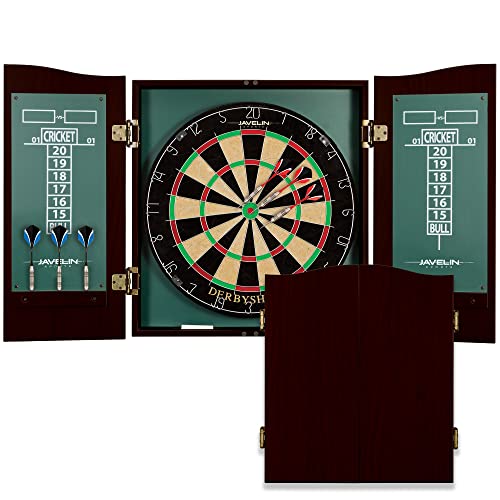
EastPoint Derbyshire Official Size Dart Board Cabinet, 6 Steel Tip Darts
Check availability on Amazon ↗Paid link · #CommissionsEarned
Accudart Armada Bristle Dartboard Cabinet Set, 18-Inch
Check availability on Amazon ↗Paid link · #CommissionsEarned
As an Amazon Associate, we earn from qualifying purchases. Product links are paid links; availability can change.
Turn the answer into a better game
Use the relevant tool or playing guide next instead of leaving the answer on the screen. You can play the Road to the Crown darts game, measure a lane with the setup calculator, or return to our dart boards homepage to compare board types and plan a complete setup.
Frequently asked questions
Is dartboard height measured to the bullseye?
Yes. Measure 5 feet 8 inches from the player’s finished floor to the exact centre of the inner bull.
Does an electronic dartboard use the same height?
The standard bull height is generally 5 feet 8 inches, but follow the specific machine or league instructions if they prescribe otherwise.
Should a dart mat be included in the height measurement?
If the player stands on the mat and it materially raises the stance, account for its thickness. The reference is the actual standing surface.
The Throw Lab verdict
Place the bull at 68 inches above the surface where the player stands. Focus on the bull rather than the case, cabinet or mounting screw, and account for mats or sloping floors. Once mounted, level the board, stabilize it against the wall and remeasure after accessories are installed. Finish by setting the oche from the board face. That sequence gives the target the correct vertical relationship to the thrower and avoids a deceptively neat but inaccurate installation. Verify it periodically so settling hardware never becomes an unnoticed training variable.