Quick answer: Choose bristle for traditional steel-tip feel and quiet self-healing fibers; choose electronic for soft-tip safety, automatic scoring and built-in games.
Playing feel and competitive relevance
Bristle boards accept steel-tip darts into compressed sisal and deliver the familiar sound and visual feedback associated with traditional pub and tournament darts. Players who intend to enter steel-tip leagues benefit from practicing on the same board type, at the same height and throw distance, with the same need to calculate scores. Electronic boards use perforated plastic segments and soft tips. Their scoring beds can feel different, and house rules may use a different throw distance, but they are directly relevant to soft-tip competition and casual electronic play.
For skill transfer, choose the format you expect to play most often. A steel-tip player gains little from buying automatic scoring if the plastic segment geometry changes the target they must later hit. A family that mainly wants quick games may gain more actual practice from an electronic board because setup and arithmetic never become barriers.
Safety, walls and shared rooms
Soft tips reduce the puncture hazard posed by steel points, but an electronic board is not risk-free: darts can still strike faces, eyes or fragile objects. A clear lane and supervision remain necessary. Steel-tip setups need a generous surround or backboard, protected flooring and firm rules about retrieving darts only after the thrower finishes. Magnetic boards are safer still for very young children, although they are outside this head-to-head comparison.
For apartments, impact transmission matters as much as volume in the room. Bristle is usually quieter at the board face, while a plastic electronic matrix can produce a sharper click. Either mount can carry vibration into a shared wall. A freestanding mount or isolated backing may improve the situation, provided the board remains secure.
Scoring, games and social play
Electronic boards win on convenience. They can total turns, enforce many game rules, prompt the next player and offer Cricket, X01 and novelty variants without a separate scoreboard. Check the maximum player count, display readability, sound controls and whether the advertised game total includes small variations of the same game. Bristle requires manual scoring or a companion app, but that arithmetic teaches checkout awareness and keeps rules transparent.
Automatic scoring is only as reliable as the segment registration. A soft dart that bounces out may still register on some boards, so groups should agree whether the machine or the physical dart decides the score. On bristle, a dart normally must remain in the board until called and retrieved under the rules being used.
Durability and ongoing ownership
A good bristle board can remain useful for years when kept dry, rotated regularly and used with suitable points. Wear is visible and gradual, especially around triple 20. An electronic board adds sensors, displays, buttons, power supplies and replaceable plastic tips. Those features increase convenience but also create more possible failure points. Review warranty coverage and replacement-part availability rather than comparing purchase price alone.
Maintenance differs rather than disappearing. Bristle owners rotate the number ring, inspect points and avoid liquids. Electronic owners replace bent tips, remove broken tip fragments correctly, keep liquids away from circuitry and avoid steel points completely. Neither board should be treated as weatherproof unless the manufacturer explicitly says so.
Which board should you choose?
Choose bristle for serious steel-tip practice, a traditional game room, quieter impacts or a board that works without power. Choose electronic for soft-tip leagues, larger casual groups, built-in games or players who want the score handled automatically. For a family with teens and adults, either can work; base the decision on supervision and preferred games rather than assuming soft tip is automatically childproof.
If still undecided, list the three people most likely to play and the two games they will play weekly. Then compare board dimensions, lane clearance, noise restrictions and total setup cost. The board that is used twice a week is a better purchase than the theoretically superior one that stays covered.
Current equipment to compare
Use these verified listings as a starting set, then confirm the selected variation, dimensions, compatibility and current order terms on the retailer page. Inclusion is not a claim of hands-on testing or a universal ranking.

WINMAU Blade 6 Single Core Dartboard - Tournament Specification Board
Check availability on Amazon ↗Paid link · #CommissionsEarned
Accudart Match Pro Dartboard Cabinet Set with Auto LED
Check availability on Amazon ↗Paid link · #CommissionsEarned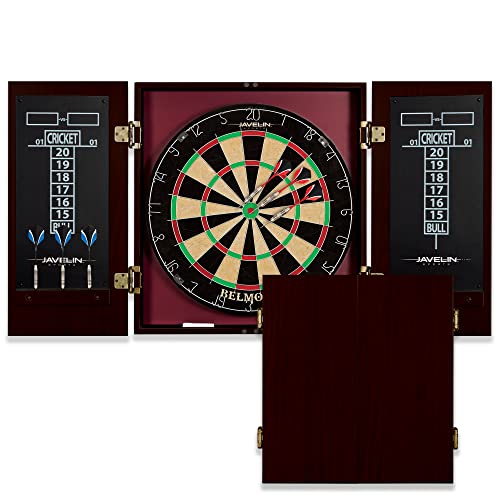
As an Amazon Associate, we earn from qualifying purchases. Product links are paid links; availability can change.
Turn the answer into a better game
Use the relevant tool or playing guide next instead of leaving the answer on the screen. You can play the Road to the Crown darts game, measure a lane with the setup calculator, or return to our dart boards homepage to compare board types and plan a complete setup.
Frequently asked questions
Is an electronic dartboard easier for beginners?
It removes scorekeeping friction and teaches game order, so many beginners start playing sooner. It does not automatically teach steel-tip checkout math or reproduce bristle-board feel.
Does a bristle board require bristle darts?
Use steel-tip darts made for sisal/bristle boards. The word bristle describes the board category; modern quality boards are normally compressed sisal, not animal bristles.
Can one set of darts work on both boards?
Convertible darts can accept interchangeable steel and soft points when the barrel threading is compatible. Always confirm the electronic board's permitted dart weight and never throw steel points at its plastic matrix.
The Throw Lab verdict
Bristle is the stronger choice when authentic steel-tip practice, simple construction and traditional feel lead the brief. Electronic is the better fit when automatic scoring, soft-tip play and a large built-in game library will get more people throwing. Compare both on the same six criteria—format, safety plan, noise, scoring, maintenance and expected games—then buy for repeated use. For many enthusiasts the long-term answer is eventually one of each, but a first board should match the format played by the household today.