Quick answer: Anchor the cabinet into framing or properly rated wall hardware, level it, then position the board so the bull—not the cabinet—is exactly 5 ft 8 in high.
Choose anchors for the complete load
Account for cabinet, board, stored darts, lights and accessories. Whenever possible, drive cabinet fasteners into wall studs or solid masonry using hardware suited to the substrate. If stud spacing does not match the mounting points, a securely fixed ledger or backer can distribute the load.
Drywall anchors must be rated for the actual assembly and installed exactly as specified. Repeated dart impact creates vibration that a simple picture hook was never designed to handle. If the wall construction is uncertain, have the mounting method evaluated before play.
Lay out height and door clearance
Hold or template the cabinet at the proposed location and open both doors fully. Check switches, adjacent walls, shelves and lighting. The board should remain visible from the oche without a door edge intruding into the sightline.
Mark the intended bull position at 68 inches above the playing floor. Transfer that position into the cabinet using the board bracket’s dimensions. Do not assume equal space above and below the target will automatically produce the right height.
Level the case before fitting the target
Use a level across the cabinet body, not a potentially uneven ceiling or trim line. Pre-drill as appropriate, support the weight during fastening and tighten in stages so the case does not twist. Recheck level with doors open because sag can expose a mounting problem.
Fit scoreboards, catches and lighting cables before the dartboard blocks access. Keep wiring protected from points and route it away from hinges. No metal hardware should remain exposed in common miss areas.
Mount and stabilize the board
Attach the board bracket at the calculated location, seat the board and adjust rear bumpers until the face is parallel and stable. Rotate the board so the 20 is vertical. Check that the number ring and board can still be removed for routine rotation.
Measure floor to bull again, then project the playing face to the floor and set the oche. Cabinet depth changes the face-to-wall relationship, which is why an old throw line may no longer be valid.
Complete the cabinet for everyday use
Set door catches so they hold the cabinet open without requiring force that shakes the target. Chalkboards should be readable from a normal scoring position, and erasers, markers and spare darts need holders that do not obstruct closure. If the doors carry printed checkout tables, verify that reflected light does not create glare from the oche. Small felt pads can stop closing noise and protect the finish.
After a week of play, recheck cabinet level and all mounting fasteners. Wood can settle, hinges can loosen and stored equipment adds load. Open and close the doors while watching the board face for movement; any shift indicates the case or bracket needs attention. A cabinet that remains square allows the board to be rotated and the doors to align without repeatedly disturbing regulation height.
Current equipment to compare
Use these verified listings as a starting set, then confirm the selected variation, dimensions, compatibility and current order terms on the retailer page. Inclusion is not a claim of hands-on testing or a universal ranking.
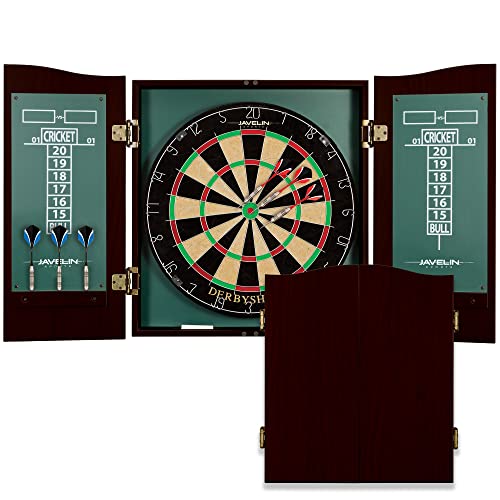
EastPoint Derbyshire Official Size Dart Board Cabinet, 6 Steel Tip Darts
Check availability on Amazon ↗Paid link · #CommissionsEarned
Accudart Armada Bristle Dartboard Cabinet Set, 18-Inch
Check availability on Amazon ↗Paid link · #CommissionsEarned
As an Amazon Associate, we earn from qualifying purchases. Product links are paid links; availability can change.
Turn the answer into a better game
Use the relevant tool or playing guide next instead of leaving the answer on the screen. You can play the Road to the Crown darts game, measure a lane with the setup calculator, or return to our dart boards homepage to compare board types and plan a complete setup.
Frequently asked questions
Should the cabinet or dartboard be centred at 5 feet 8 inches?
The bullseye must be 5 feet 8 inches high. Place the cabinet as needed to support that target position and its internal layout.
Can a dartboard cabinet hang from drywall anchors?
Only with anchors suitable for the wall and full dynamic load. Stud or masonry attachment is preferable for a heavy cabinet exposed to repeated impact.
Do I mark the oche before hanging the cabinet?
No. Install the cabinet and board first, then measure from the finished playing face because the cabinet changes projection from the wall.
The Throw Lab verdict
Treat a dartboard cabinet as active sports equipment rather than wall décor. Support its full load with appropriate structure, verify door clearance, level the case and locate the bull independently at 68 inches. Stabilize the board without blocking rotation, conceal wiring and hard rebound points, then set the oche from the completed board face. That sequence produces a cabinet that remains aligned, usable and safe after hundreds of turns. Reinspect fasteners after the assembly settles and whenever the doors begin to sag.