Quick answer: Use a purpose-built stand for a truly no-drill setup. Adhesive-only mounting is usually inappropriate for the weight and repeated impact of a regulation bristle board.
Freestanding stands are the most flexible option
A purpose-built tripod or weighted stand keeps the board independent of the wall and can move between rooms. Look for adjustable bull height, a bracket compatible with the board, rear stabilization and a footprint that does not enter the player’s stance area. Wider bases generally resist impact movement better.
Place protective material behind the target because a stand does not stop misses. On smooth floors, use non-slip feet or the manufacturer’s recommended ballast. Verify that children or pets cannot pull the frame over.
Door and tension mounts need careful inspection
Over-door systems must fit the door thickness and allow the door to be secured against movement during play. Confirm that the frame, hinges and bracket can carry the load. The door should never open into an occupied space while darts are being thrown.
Floor-to-ceiling tension poles avoid holes but depend on sound, non-sloping surfaces and correct compression. Follow load limits and recheck tension periodically. Neither approach is suitable if it damages trim, blocks an exit or leaves the board swaying.
Why adhesive mounting is risky
A bristle board’s weight creates constant peel and shear force, while incoming darts add small repeated shocks. Paint adhesion, humidity and surface texture introduce variables that adhesive ratings cannot eliminate. Even if a strip holds initially, removal may lift paint or paper.
Adhesive can be reasonable for light magnetic roll-up toys when the product instructions allow it. It should not be generalized to regulation boards, cabinets or heavy surrounds.
Measure a portable lane every time
Set the bull centre at 5 feet 8 inches from the actual floor, then drop a plumb line from the face and mark the steel-tip oche at 7 feet 9 1/4 inches. A removable laser line or dart mat can speed repeated setups, but verify alignment after moving the stand.
Before each session, push the frame gently from multiple directions and confirm it returns stable without rocking. Check the board remains vertical and that all locking knobs are tight. Portability is useful only when setup checks become part of the routine.
Choose portability without creating new hazards
Folded stands and removable mounts require storage planning. Secure loose legs, brackets and the board during transport so a heavy target cannot tip from a closet or vehicle. If the board stays attached to a stand while moved, use two people when the manufacturer recommends it and never lift by an adjustment knob. Reassembly instructions should travel with the equipment.
Outdoor temporary use adds wind and uneven ground to the stability problem. A stand designed for indoor floors may be unsafe on grass or a sloped patio, and sisal must not be left in moisture or direct weather. Treat every location as a fresh installation: assess traffic, establish backing, level the bull, mark the line and restrict access until the frame passes a deliberate push test.
Mark each stand adjustment with removable tape after the first accurate setup. These reference marks speed assembly without replacing measurement. If a clamp slips or a telescoping leg no longer reaches its mark, stop play and inspect the mechanism rather than compensating by moving the oche.
Current equipment to compare
Use these verified listings as a starting set, then confirm the selected variation, dimensions, compatibility and current order terms on the retailer page. Inclusion is not a claim of hands-on testing or a universal ranking.
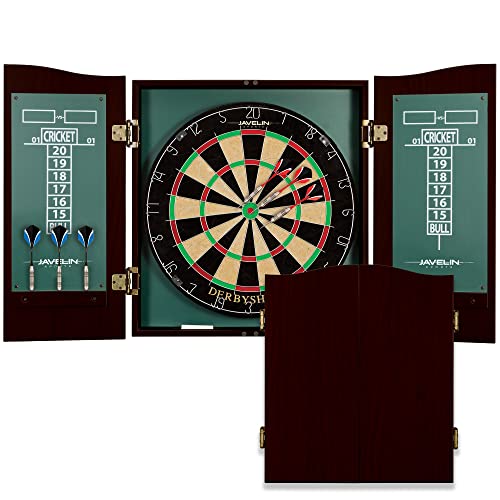
EastPoint Derbyshire Official Size Dart Board Cabinet, 6 Steel Tip Darts
Check availability on Amazon ↗Paid link · #CommissionsEarned
Accudart Armada Bristle Dartboard Cabinet Set, 18-Inch
Check availability on Amazon ↗Paid link · #CommissionsEarned
As an Amazon Associate, we earn from qualifying purchases. Product links are paid links; availability can change.
Turn the answer into a better game
Use the relevant tool or playing guide next instead of leaving the answer on the screen. You can play the Road to the Crown darts game, measure a lane with the setup calculator, or return to our dart boards homepage to compare board types and plan a complete setup.
Frequently asked questions
Can Command strips hold a regulation dartboard?
They are not a prudent primary support for a heavy board exposed to impact. Use a rated stand or mechanical mounting system designed for darts.
Will a dartboard stand wobble?
A well-designed, correctly assembled stand on a level surface should remain stable. Use its braces, non-slip feet and approved ballast, and tighten adjustments regularly.
Can I hang a dartboard over a door?
Only with a purpose-built bracket and a door that can be secured during play. Confirm load capacity, clearance and safe traffic flow first.
The Throw Lab verdict
For renters and multipurpose rooms, a stable purpose-built stand is the strongest no-drill answer. Door and tension systems can work when their ratings, surfaces and clearances are appropriate; adhesive strips should be reserved for very light products. Protect the wall, measure the lane after every move and perform a stability check before throwing. A reversible installation should still feel solid enough that the target position never changes during a game. Reference marks on adjustable parts make accurate repeat installations faster and easier to verify.