Quick answer: Combine a dense surround or backboard with secure mounting and a clear throwing lane. Beginners generally need a wider protected area.
Map the real risk area
Mark the board centre, then consider misses beyond every edge rather than only around the 20. Beginners may release early, pull darts sideways or drop them well below the doubles ring. A full rectangular backboard is more protective than a ring when skill levels vary.
Watch several supervised practice turns before finalizing decorative trim. Temporary cardboard can reveal the distribution of misses, but it is not a permanent stopping surface. Enlarge the protected zone if darts regularly reach its border.
Build a layered barrier
A dependable barrier combines a point-catching face with enough depth or a secondary layer to keep tips from reaching drywall. Dense cork, rubber or engineered dartboard foam can form the face; plywood or suitable softwood can add structure. Test offcuts safely before trusting an unfamiliar material.
Cover or countersink fasteners and avoid knots, brackets or metal trim in the impact area. Hard objects can bend points and cause rebound. Fabric may improve appearance, but it should cover a stopping layer rather than serving as the only protection.
Prevent damage below the board
A dart mat protects flooring and marks the oche, while carpet tiles or resilient flooring can soften bounce-outs. Pay attention to the strip immediately beneath the board, where darts that strike wire or arrive loosely often fall point-first. Keep power cables and loose rugs out of this zone.
If the floor is tile or concrete, the point may suffer even when the floor seems unharmed. A removable mat lets a multipurpose room return to normal while extending the life of darts.
Preserve access and alignment
Do not permanently trap a bristle board inside the backing. The number ring should be removable so the board can be rotated, and the mounting bracket should remain accessible for adjustment. Lighting and cabinet doors also need clear travel.
After installing protection, re-establish the bull height and throw line from the finished board face. Backing thickness can shorten an existing lane, and a crooked panel can tempt installers to level the board against the wrong visual reference.
Repair and monitor the protection system
Remove embedded broken tips with the correct tool before they become hidden hard spots. Replace deeply channelled foam, crumbling cork or split wooden faces instead of covering the damage with another decorative layer. A sacrificial front panel can make renewal inexpensive while the structural backing remains mounted. The region around triple 20 may also wear from darts removed carelessly, even though it lies on the board rather than the wall.
After moving the target or rotating a large backboard, inspect the original wall for moisture and anchor damage. Basements and garages can trap humidity behind broad panels; sisal and untreated backing both suffer in damp conditions. Spacing that preserves ventilation must not create a gap deep enough for darts to disappear or strike hidden wiring. Maintenance is what keeps an initially protective installation safe over years of play.
Current equipment to compare
Use these verified listings as a starting set, then confirm the selected variation, dimensions, compatibility and current order terms on the retailer page. Inclusion is not a claim of hands-on testing or a universal ranking.
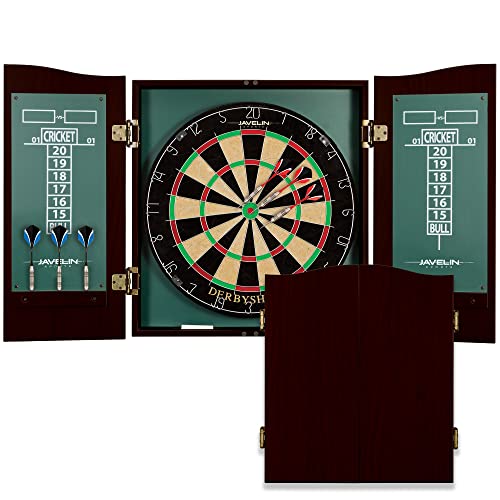
EastPoint Derbyshire Official Size Dart Board Cabinet, 6 Steel Tip Darts
Check availability on Amazon ↗Paid link · #CommissionsEarned
Accudart Armada Bristle Dartboard Cabinet Set, 18-Inch
Check availability on Amazon ↗Paid link · #CommissionsEarned
As an Amazon Associate, we earn from qualifying purchases. Product links are paid links; availability can change.
Turn the answer into a better game
Use the relevant tool or playing guide next instead of leaving the answer on the screen. You can play the Road to the Crown darts game, measure a lane with the setup calculator, or return to our dart boards homepage to compare board types and plan a complete setup.
Frequently asked questions
Will a dartboard surround stop every miss?
No. A surround catches darts near the board but cannot cover wide beginner misses. Add a larger panel when wall damage would be costly.
Can I use plywood behind a dartboard?
Plywood can provide structure and wall coverage, but a softer point-catching face reduces bounce-back and point damage. Countersink every fastener.
How do I protect a concrete floor?
Use a purpose-built dart mat or dense resilient floor covering beneath the target and lane. This protects dart points from bounce-outs as well as the surface.
The Throw Lab verdict
Protect a wide enough area for the actual players, not merely the board’s outline. Use a dense, sufficiently thick stopping layer, conceal hard fasteners and add floor coverage below the target. Keep the board accessible for rotation and remeasure its height and oche after installation. The strongest solution treats wall, floor and rebound risk as one system, producing a cleaner room and a safer lane without turning maintenance into a demolition project. Check damaged areas regularly so yesterday’s protection does not become tomorrow’s weak spot.